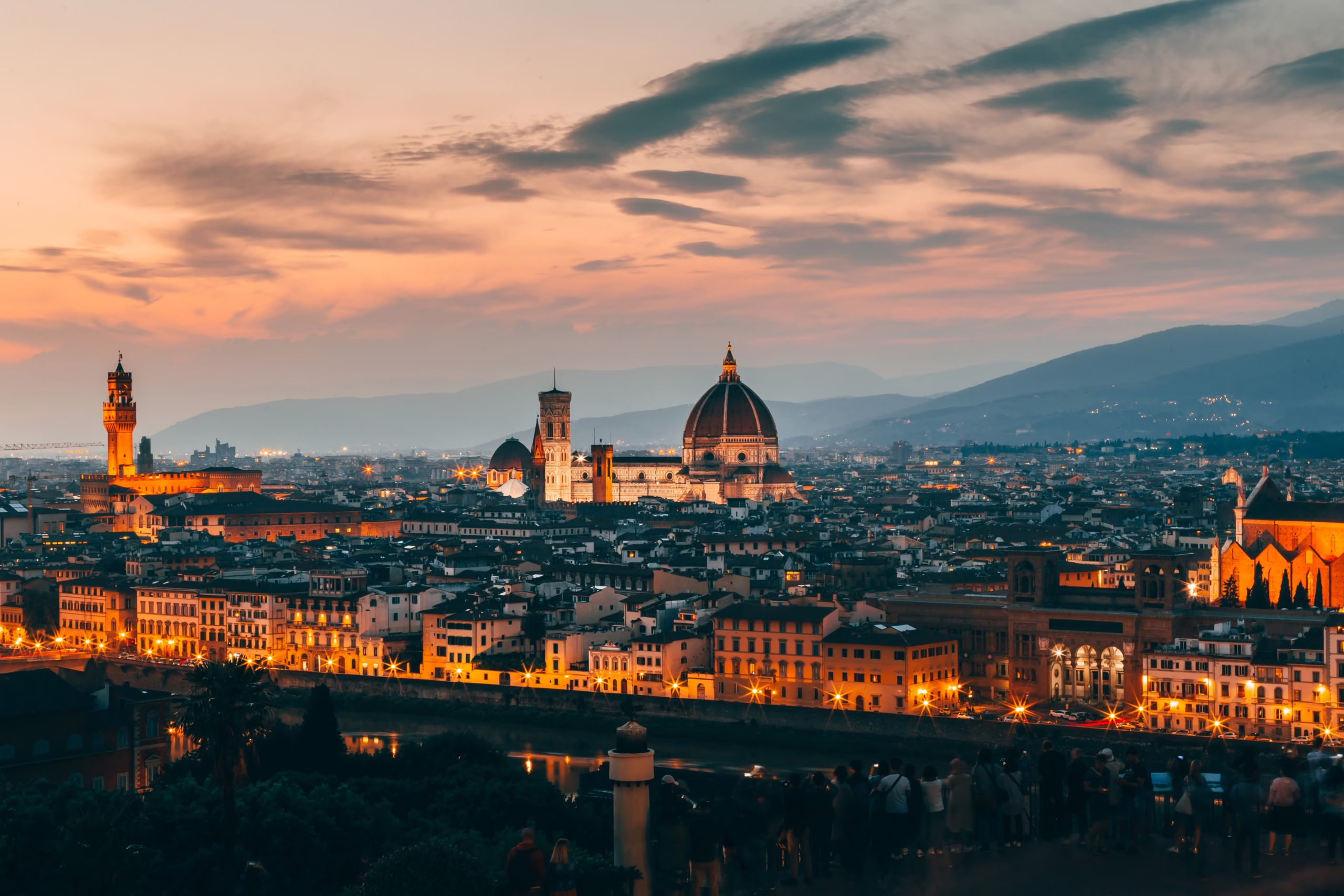
Europe packs an entire planet’s worth of variety into one continent. You can eat pasta in a Roman trattoria on Monday and be hiking past Norwegian fjords by Friday, without ever leaving a two-hour flight radius. That’s exactly what makes «best places to visit in Europe» such a hard question to answer with a single list — the right destination depends entirely on what kind of trip you’re actually trying to have.
This guide breaks Europe down by region and travel style, so instead of a generic ranking, you get a practical starting point: where to go, how long to stay, when to visit, and what each place is genuinely worth the trip for.
How to Use This Guide
Before diving in, it helps to think about your trip along three axes:
- Pace — city-hopping, or settling into one or two bases?
- Season — peak summer crowds, or shoulder-season quiet?
- Interest — history and art, food and wine, nature and outdoors, or nightlife and beaches?
Every destination below is tagged with what it’s best for, so you can match it to your own answer rather than someone else’s idea of a «must-see.» This guide also reflects the entry rules, fees, and crowd-control measures that are actually in place for 2026 and 2027 travel — several of Europe’s most popular spots have changed meaningfully in the last year.
Quick-Reference: Europe’s Top Destinations at a Glance
| Destination | Best For | Ideal Trip Length | Best Time to Visit |
|---|---|---|---|
| Paris, France | First-time visitors, art & architecture | 3–5 days | April–June, September–October |
| Rome, Italy | Ancient history, food | 3–4 days | April–May, September–October |
| Barcelona, Spain | Architecture, beach + city combo | 3–4 days | May–June, September |
| Amsterdam, Netherlands | Walkable charm, museums | 2–3 days | April–May (tulips), June–August |
| Santorini & the Greek Islands | Views, romance | 4–6 days | Late May–June, September |
| Lisbon, Portugal | Value, coastal day trips | 3–4 days | March–May, September–October |
| Prague, Czech Republic | Budget-friendly, architecture | 2–3 days | May, September |
| Iceland | Nature, road trips | 5–7 days | June–August (light), Feb–March (aurora) |
| The Amalfi Coast, Italy | Scenery, slow travel | 3–5 days | May–June, September |
| Switzerland (Interlaken/Lucerne) | Mountains, outdoor activity | 4–6 days | June–September |
| Croatia (Dubrovnik/Split) | Coastline, island-hopping | 5–7 days | June, September |
| Budapest, Hungary | Value, thermal baths | 2–3 days | April–May, September–October |
| Vienna, Austria | Classical culture, elegance | 2–3 days | April–May, December (markets) |
| Norway’s Fjords | Dramatic landscapes | 5–7 days | June–August |
| Edinburgh, Scotland | History, festivals | 2–3 days | May, August (Fringe Festival) |
Western Europe: The Classic Starting Point
Paris, France remains the reference point for a reason. Beyond the Eiffel Tower and the Louvre, the city rewards slower exploration — a morning in the Marais, an afternoon along the Seine, dinner in a neighborhood bistro with no line outside. First-time visitors should budget at least three full days; five lets you add a day trip to Versailles without feeling rushed.
Amsterdam works best as a base for wandering rather than a checklist of sights. The canal ring, the Jordaan district, and world-class museums like the Van Gogh and Rijksmuseum are all within walking or cycling distance of each other. Two to three days is enough for the city itself; more if you want to combine it with the Dutch countryside.
Switzerland is less a single destination than a network of small, spectacular bases — Interlaken for the Jungfrau region, Lucerne for its lake and Old Town, Zermatt for the Matterhorn. It’s expensive relative to the rest of Europe, but the train network makes it one of the easiest countries on the continent to explore without a car.
Southern Europe: History, Food, and Coastline
Rome is dense with history in a way few cities can match — the Colosseum, the Forum, and the Vatican are all within a compact center, which also means you can cover a remarkable amount on foot. Three to four days lets you see the major sites without spending every meal rushing between them.
The Amalfi Coast rewards a different pace entirely. This is a place to slow down: a boat trip to Capri, a hike along the Path of the Gods above Positano, long lunches with a sea view. It pairs naturally with Naples or Rome as a start or end point.
Barcelona combines Gaudí’s architecture (the Sagrada Família and Park Güell are the obvious anchors) with genuine beach access and one of Europe’s best food scenes. It’s one of the few major European cities where you can reasonably split a day between museums and the Mediterranean. Worth budgeting for: Catalonia raised its tourist tax again as of April 2026, and Barcelona’s nightly surcharge is now on a scheduled climb through 2029, so accommodation costs run higher than they did just a year or two ago, especially at four- and five-star hotels.
Santorini and the Greek Islands are worth the hype for sunset views and whitewashed villages, but the islands vary a lot — Santorini is romantic and photogenic, Naxos and Paros are quieter and better value, Crete is large enough to feel like its own country. Island-hopping needs more time than most people budget for; plan on at least a week if you’re visiting more than one. Santorini specifically is worth reconsidering if you wrote it off in the past: Greece introduced a hard daily cap on cruise passengers in 2025 and tightened it further for 2026, cutting peak-day crowds roughly in half and making Fira and Oia noticeably more walkable than in prior years.
Lisbon has become one of Europe’s best-value city breaks. The city itself takes two to three days, and it’s an easy base for day trips to Sintra’s palaces or the beach towns along the Cascais coastline.
Croatia’s Dalmatian Coast, anchored by Dubrovnik and Split, offers a mix of walled old towns, island ferries, and the kind of clear-water coastline that rivals Greece at a lower price point.
Central & Eastern Europe: Value and Architecture
Prague is often the first stop for travelers exploring Central Europe, and its combination of preserved medieval architecture and low costs relative to Western Europe makes it an easy sell. Two to three days covers the major sights comfortably.
Budapest pairs a similarly walkable, architecturally rich Old Town with a genuinely unique feature: thermal bath culture. Soaking in the Széchenyi or Gellért baths is as much a part of visiting Budapest as sightseeing is.
Vienna leans more formal — imperial palaces, classical music, coffeehouse culture — and works well combined with either Budapest or Prague as part of a Central Europe itinerary.
Northern Europe: Nature at Scale
Iceland has shifted from niche destination to bucket-list staple, and the Ring Road makes it genuinely feasible to self-drive past waterfalls, black-sand beaches, and geothermal pools in a single trip. Summer brings near-endless daylight; winter brings the chance of the northern lights, at the cost of shorter days and trickier driving conditions.
Norway’s fjords — Geirangerfjord and Nærøyfjord in particular — are best experienced by a mix of ferry, train, and short hikes rather than any single viewpoint. This is a trip that benefits from a full week; the distances between highlights are longer than they look on a map.
Edinburgh rounds out the north with a completely different character — a compact, hilly Old Town, easy access to the Highlands, and a festival calendar (the Fringe in August above all) that can define when you choose to visit.
Travel Rules and Costs to Know Before You Go (2026–2027)
Europe’s entry requirements and tourist fees have shifted more in the past two years than in the previous decade, and several changes directly affect trip planning and budgeting.
ETIAS travel authorization. The EU’s new pre-travel screening system for visa-exempt visitors (including US, UK, Canadian, and Australian passport holders) has been delayed repeatedly and, as of mid-2026, still doesn’t have a confirmed start date — a «last quarter of 2026» launch has been floated, but a 2027 rollout is now considered more likely by most travel-industry trackers. Once it does go live, there’s expected to be a soft-launch window of several months during which travelers can still enter without it, followed by a period where it becomes mandatory. The fee has already been set at €20, and authorizations last three years once issued. Because the timeline keeps moving, it’s worth checking the status shortly before booking rather than relying on any specific date.
Venice’s day-tripper fee. Venice now charges same-day visitors (not overnight guests) a fee to enter the historic center on the city’s busiest dates. For 2026, that applies across 60 days between April and July, mostly Fridays through Sundays and holiday periods, at €5 per person if booked in advance or €10 for late bookings. Overnight guests are exempt, since they already pay Venice’s separate per-night accommodation tax.
Barcelona and Catalonia’s tourist tax. As of April 2026, Catalonia’s regional stay tax combined with Barcelona’s municipal surcharge pushed the total nightly tourist tax as high as €12 per person for five-star hotels in the city, with lower tiers for other accommodation types. The city has a scheduled annual increase in place through 2029, so this is a cost that will keep climbing rather than a one-off adjustment.
Santorini and Mykonos cruise fees and caps. Beyond the new cruise passenger cap mentioned above, Greece charges cruise travelers a per-person port fee that scales with season — around €20 at peak summer, dropping to €12 in shoulder months and €4 in winter, at Santorini and Mykonos specifically. It doesn’t apply if you don’t disembark, and it’s unrelated to costs for travelers arriving by ferry or air.
None of this should discourage a European trip — if anything, measures like Santorini’s cruise cap have made some previously overwhelmed destinations more pleasant to visit. But it’s worth building these fees into your budget rather than being surprised by them at the border or checkout.
Sample Two-Week Itinerary: Western & Southern Europe
For travelers trying to combine several of these in one trip, this route balances cities, coastline, and travel time:
- Days 1–4: Paris — city sights, day trip to Versailles
- Days 5–6: Travel + Barcelona (high-speed train or short flight)
- Days 7–9: Barcelona — Gaudí sites, beach afternoon, tapas crawl
- Days 10–11: Travel + Rome
- Days 12–14: Rome — Colosseum, Vatican, Trastevere
This keeps transit days to a minimum while still covering three very different countries — a reasonable template to adapt with your own priorities.
When to Go: Avoiding the Peak-Summer Crowd Crush
July and August are peak season almost everywhere on this list, which means the highest prices, the longest lines, and — in destinations like Santorini or the Amalfi Coast — genuinely overwhelmed infrastructure. Shoulder seasons (April–June and September–October) usually offer a better balance of good weather and manageable crowds, and they’re worth prioritizing for city-focused trips in particular. Nature-driven destinations like Iceland and Norway are more season-locked, since long summer daylight is central to the experience.
Frequently Asked Questions
What is the best country to visit in Europe for a first trip? France, Italy, and Spain cover the widest range of the «classic Europe» experience — major art and history, strong food culture, and cities that are easy to navigate without a car. Any of the three makes a solid first-timer base, and they connect to each other easily by train or short flight.
How many countries should I try to visit in two weeks? Two to three, generally. Trying to cover more usually means spending a disproportionate share of the trip in transit rather than actually experiencing each place. It’s almost always better to see fewer destinations properly than to rush through a longer list.
Is it cheaper to visit Eastern or Western Europe? Eastern and Central Europe — Prague, Budapest, and similar cities — are typically 30–50% cheaper than Western European capitals for accommodation and food, which makes them a strong choice for longer or budget-conscious trips.
What’s the best time of year to visit Europe overall? Late spring (May–June) and early fall (September–October) offer the best combination of good weather, manageable crowds, and lower prices across most of the continent, with the exception of far-northern destinations tied to summer daylight.
Do I need ETIAS to visit Europe right now? Not yet. As of mid-2026, ETIAS has not launched and visa-exempt travelers (US, UK, Canada, Australia, and others) can still enter with just a valid passport. The system is expected to launch sometime in late 2026 or 2027, with a transitional grace period after launch before it becomes strictly mandatory. Any website currently charging for an ETIAS application is not legitimate — check the official EU travel authorization site before applying once it opens.
Deja una respuesta